If you’ve ever been part of a manufacturing project where you have to juggle a dozen different vendors, fix misaligned timelines, and deal with parts that just don’t fit—you’ll get why I’m such a fan of turnkey paint lines. I’m the guy on the supplier end of these projects, and every week I get emails from people asking the same question: “What’s the actual production capacity of a turnkey paint line?” It’s not a one-number answer, which makes total sense once you break down all the moving parts that go into getting a part from raw metal or plastic to a finished, ready-to-ship coat of paint. Let me walk you through how we figure this out, from the basics to the tiny details that end up making or break a line’s real-world performance. Turnkey Paint Line

First off, let’s nail down what we mean by turnkey here. This isn’t just a spray gun and a booth you bolt together in a corner. A proper turnkey paint line is a full, integrated system: surface prep (washing, degreasing, sanding, sometimes phosphating to make paint stick), the actual paint application (sprayers, electrostatic guns, maybe robotic arms if that’s what the customer wants), curing (oven that bakes the paint so it hardens), and even a small quality check zone before parts go out. When someone asks about production capacity, they’re not asking about how fast a single gun can spray—they want to know how many parts the whole line can pump out in a day, a shift, or a year, without bottlenecks grinding everything to a halt.
Let’s start with the biggest variable: part size and type. I can’t tell you how many times someone calls and says “I need a line that does 10,000 parts a day” without even mentioning if those parts are small, like plastic appliance handles, or huge, like metal truck frames. A line for tiny, identical parts can run way faster than one for big, irregular items that need careful positioning. For example, we recently wrapped up a project for a consumer goods company making blender jars—they’re small, cylindrical, easy to load and unload on a conveyor, so their line hits around 1,800 pieces per 8-hour shift. Then last year we did a line for heavy equipment parts, like side panels for excavators—each one is 4 feet tall, has weird edges and mounting holes, and a crew can only load a few an hour. That line tops out at about 200 parts per shift. Same “capacity” ask, totally different numbers because of part size.
Next up, line speed and conveyor type—this is the backbone of capacity, no cap. Conveyors move parts through every zone: wash, dry, paint, cure, cool down. The speed depends on how long each zone needs to be to do its job right. If a part needs 10 minutes in the curing oven to get a hard, durable finish, that oven has to be long enough that when the conveyor moves parts through, they spend exactly 10 minutes inside. For blender jars, the cure time is only 5 minutes, so the oven can be shorter, the conveyor can move faster, and that adds up to more parts per shift. For excavator panels, cure time is 20 minutes because they’re thick metal that needs more heat to set, so the oven has to be longer, conveyor moves slower, hence fewer parts. Also, conveyor type matters: overhead monorail conveyors are the most common for turnkey lines because they lift parts off the floor, so loading/unloading is easier, and parts don’t get in each other’s way. If a customer uses a power-and-free conveyor, that lets you hold parts in line for a zone if something backs up, which can help with consistency, but doesn’t necessarily boost speed—though it can prevent downtime that kills capacity.
Then there’s the stuff that people don’t think about at first: shift length, downtime, and changeovers. A line that runs 24/7 without stopping will obviously have way higher capacity than one that only runs 8 hours a day, 5 days a week. But real-world capacity isn’t the “theoretical maximum” you see on a spec sheet—it’s the “actual, what you’ll get every week” number, which accounts for stops for maintenance, cleaning spray guns, fixing small conveyor issues, and switching between part runs. For example, if a company is running blender jars one week, then switching to coffee mugs the next, they have to clean all the paint lines, recalibrate sprayers, adjust conveyor holders for the new part, and that takes a couple hours per changeover. That eats into production time, so if you plan on 16 shifts a month, you might only get 14 after changeovers. We always build that into our quotes—we don’t sell theoretical capacity, we sell the realistic number based on how their operation works, because that’s what actually matters.
Automation level is another big one, and it’s a trade-off between speed and flexibility. A fully robotic line that uses 6-axis arms to spray parts can run 24/7, never gets tired, and is super consistent, so capacity is really high. We had a customer in the automotive parts space with a fully automated line—they were doing 12,000 identical wheel covers per 24-hour shift, no downtime except for weekly maintenance. But that line only does wheel covers; if they wanted to switch to a different part, it would take a whole day to reprogram the robots and adjust the conveyor, so changeovers are way slower. On the other end, a semi-automated line with a few robotic sprayers plus some manual stations for tricky parts is more flexible, but might have lower capacity because manual workers can only move so fast. For example, a line for outdoor furniture: most parts are chairs that can be robot-sprayed, but the armrests have curves that the robot can’t reach perfectly, so a worker has to touch them up. That adds a step, so capacity ends up being around 800 chairs per shift, which is lower than a fully automated line, but the customer can switch between chairs, tables, and benches without major downtime.
Wait, let’s not forget about quality and compliance, because that directly affects how much you can actually produce without wasting parts. If your line is spraying too thick or too thin, you’ll have to scrap parts, which kills capacity. We design our turnkey lines with that in mind—we install sensors that monitor spray thickness, oven temperature, and part positioning so you don’t get 10 bad parts in a row. For example, we had a small cabinet maker come to us a few years ago, they were using a DIY line they built themselves, and they were scrapping 15% of their parts because of uneven paint. Their actual capacity was way lower than their theoretical number because of scrap. We redesigned their turnkey line, added electrostatic sprayers that apply paint evenly, and scrap dropped to less than 2%, so their real capacity went up almost 30% without adding any extra time to their shifts. That’s the kind of value we bring—capacity isn’t just about speed, it’s about not wasting what you produce.
Also, the type of paint being used makes a huge difference. Water-based paint is super common now because it’s better for the environment, but it needs longer drying times, so that affects the line speed. Solvent-based paint dries faster, so you can move parts through quicker, but has more VOCs, so you need more ventilation, which can add some length to the booth. We always work with our customers to pick the right paint for their needs, and adjust the line capacity accordingly. For example, a customer doing small electronics parts switched from solvent-based to water-based paint, and their cure time went from 3 minutes to 8 minutes. At first they thought their capacity would drop by half, but we adjusted the conveyor speed and added a small pre-cure zone to cut wait time, so they only lost 10% of their capacity, which was way better than they expected.
Now, let’s talk about how we calculate capacity for a custom turnkey line, because every project is different. First, we sit down with the customer and ask all the stupid (but important) questions: What parts are you painting? What’s their size, weight, surface? How many do you need per day/week? Do you run shifts, weekends? Do you need to switch between parts often? What’s your quality standard? Once we have that, we run the numbers: line length based on cure and dry times, conveyor speed, number of workstations, automation level, and account for expected downtime, changeovers, and scrap. We give them a realistic number, not a sales pitch number. For example, if a customer needs 5,000 appliance handles per shift, we won’t say “your line will do 5,500” if we know changeovers will eat 10% of their time and scrap is around 3%. We’ll say “realistic capacity for your operation is ~4,800 parts per 8-hour shift, which will let you hit your production goals without stress.”
I should also mention that there’s a big difference between a turnkey line and a line you put together yourself. A lot of small businesses try to save money by buying individual parts: a booth from one company, sprayers from another, a conveyor from a third. But when you mix and match, nothing works together. The conveyor is too fast for the oven, the sprayers don’t sync with the part positioning, you end up with bottlenecks everywhere, and your capacity is way lower than it should be. We do turnkey lines, meaning we design, build, test, and install the whole system, so every part works together perfectly. That’s why our lines hit the capacity numbers we quote—we don’t leave gaps that kill production.
Let me give a quick example of a recent project to put this all together. A customer that makes plastic garden tools (shovels, rakes, hoes) came to us wanting a line that could do 3,000 parts per shift. Their old DIY line was doing 1,800, and they were falling behind on orders. We started by looking at their parts: each tool is about 3 feet long, made of durable plastic, needs a thick, chip-resistant paint. They run two 8-hour shifts, 5 days a week, and switch between shovels and rakes every 2 weeks (so changeovers are a big deal). We designed a semi-automated line: overhead monorail conveyor, robotic sprayers for the main parts, manual touch-up stations for the grip areas, a water-based paint system with a 7-minute cure time, and we programmed the robotic arms so changing between shovel and rake only takes 45 minutes, not a whole day. When we installed it and ran the test cycle, the line hit 2,950 parts per shift—almost exactly what they needed, and their scrap dropped from 12% to 2.5%. They’ve been using it for 6 months now, and they’ve never missed an order, which was their biggest pain point before.
At the end of the day, production capacity of a turnkey paint line isn’t a static number you can pull off a spec sheet. It’s a combination of your parts, your operation, the system we build, and how well everything works together. If you’re in the market for a new paint line, don’t just ask “what’s the capacity?” Ask about how it works with your parts, how much downtime you’ll have for changeovers, what scrap rate you can expect, and if the whole line is integrated so nothing slows you down.
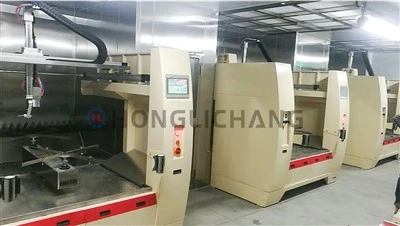
If you’re tired of lines that underperform, waste parts, or leave you scrambling to meet orders, hit me up to chat about your project. We don’t do one-size-fits-all, and we’ll give you a realistic number, not a sales pitch.
Headlamp Coating References
- Industrial Paint Application: Principles, Technologies, and Operations (3rd Edition)
- Occupational Safety and Health Administration (OSHA) Guide to Spray Painting Operations
- Society of Manufacturing Engineers (SME) Handbook: Industrial Assembly and Finishing Processes
- National Paint and Coatings Association (NPCA) Water-Based Paint Application Guidelines
Shenzhen Honglichang Machinery Manufacturing Co., Ltd.
We are one of the most professional turnkey paint line manufacturers and suppliers in China, also support customized service. Please feel free to buy advanced turnkey paint line for sale here from our factory. Welcome to contact us for quotation.
Address: No. A802, Building 2, Tianan Digital Plaza, Longgang, Shenzhen, China
E-mail: victor@honglichang.com
WebSite: https://www.honglichang-paint.com/
