If you’ve ever worked in electronics manufacturing, you’ve probably faced the quiet, frustrating problem of EMI—unwanted electromagnetic interference that can turn a smooth-running circuit into a glitchy, unreliable mess. From a sensor sending spurious readings to a power supply emitting a hum that disrupts nearby devices, EMI is a constant hurdle, and that’s where common-mode chokes come in. As someone who’s spent years designing, testing, and supplying these components for real-world applications, I’ve seen firsthand how often engineers don’t fully grasp how a common-mode choke works—they know it’s the go-to fix for EMI, but not why. Today, I want to break that down clearly, tie it to practical use cases, and show why choosing the right common-mode choke from a trusted supplier makes all the difference. Common-Mode Chokes
First, let’s start with the two types of EMI you’ll encounter: differential-mode and common-mode. Differential-mode EMI is the signal that travels along the power lines (or signal lines) themselves, in opposite directions. For example, on a power cord, the live line carries current one way, and the neutral line carries it back the other—any small, unwanted signal riding on that pair is differential-mode. This is usually easier to filter, because you can target the path between the two lines. Common-mode EMI, though, is the trickier culprit: it’s an unwanted signal that travels in the same direction on both lines, and it’s usually caused by external sources. Think of a cell phone’s antenna picking up a radio signal that leaks into your device’s power cord, or a motor’s magnetic field inducing a current that flows along both the live and neutral lines at the same time. This signal doesn’t just travel along the lines—it radiates out, and it also wreaks havoc on sensitive electronics that aren’t designed to pick up those shared signals. That’s exactly what a common-mode choke is built to stop.
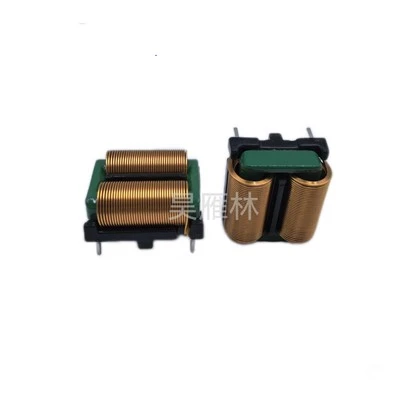
At its core, a common-mode choke is a simple component: it’s two insulated copper windings wrapped around a single toroidal (ring-shaped) core, usually made of ferrite. The live and neutral wires of a circuit are each threaded through the core, so each winding carries the current for one line. Now, here’s the key to how it works: current direction. For normal, wanted differential-mode current, the live and neutral currents flow in opposite directions. That means their magnetic fields, generated as they pass through the core, pull in opposite directions too—so they cancel each other out. From the perspective of the circuit, the core looks like it has no effect on the wanted signal. But for common-mode current? That unwanted signal flows in the same direction on both live and neutral. Their magnetic fields now add up, rather than canceling, because they’re aligned the same way. That creates a large inductive impedance (resistance to alternating current) specifically for the common-mode signal, which blocks it from passing through the choke and radiating out. Wait, let’s make that more concrete with an example: if you have a 120V AC power cord, normal differential current is 10A flowing live out, 10A flowing neutral back. The live winding’s magnetic field wraps clockwise around the core, the neutral’s counterclockwise—net magnetic field is zero, so no impedance. A common-mode signal, say 10mA of interference from a nearby wireless device, flows 10mA on both live and neutral in the same direction (both clockwise, for instance). Now their magnetic fields add up, creating a strong impedance that acts like a roadblock for that unwanted current. That’s the magic of it: it doesn’t disrupt your desired signal, but it snuffs out the EMI.
But it’s not just about the core shape or the number of windings—there’s a lot of engineering that goes into making a common-mode choke work reliably, especially for real industrial or consumer applications. For example, the ferrite core material matters a lot. Ferrites have different permeability ratings, and choosing the right one depends on the frequency of the EMI you’re targeting. If you’re dealing with high-frequency EMI (like radio signals from 10MHz to 1GHz, common in IoT devices), you need a ferrite with high permeability at those frequencies to maximize the impedance. For lower-frequency EMI, like from power line harmonics (50/60Hz plus small spikes), a different ferrite material works better. That’s why as a supplier, we don’t just ship one standard common-mode choke—we stock variants optimized for different use cases, from small 1A chokes for wearables to 50A chokes for industrial motor drives. A bad choice here, like using a low-permeability ferrite for high-frequency EMI, means the choke won’t block the interference at all, and you’re back to square one.
Another common mistake I see engineers make is mixing up common-mode chokes with regular inductors. A regular inductor is a single winding around a core, designed to pass differential current and block AC noise—but it does that by impedance for differential signals, which means it would also block part of your wanted signal. A common-mode choke, on the other hand, only impedes unwanted common-mode signals, so it doesn’t affect the proper operation of your circuit. That’s why it’s such a targeted solution. Let’s put this in a real-world scenario: a desktop computer power supply. The supply needs to pass 12V and 5V DC to the motherboard, but it also picks up EMI from the switching transistors inside the supply, which can radiate out through the power cord and cause your Wi-Fi to drop. A common-mode choke is placed right where the power cord enters the supply. It lets the 60Hz differential AC current pass through without a hitch, but blocks the 100kHz switching noise (common-mode) from escaping, and also blocks any external EMI from the grid from getting into the supply and causing glitches. Without that choke, your computer might work for a few months, but eventually, the EMI would cause intermittent crashes that are a nightmare to troubleshoot.
Testing is another big part of making sure a common-mode choke does its job. When we develop a new choke, we run it through standardized tests like CISPR 22 (for information technology equipment) or MIL-STD-461 (for military electronics) to measure its common-mode impedance across different frequencies, and its ability to attenuate EMI. We also test for thermal performance—if a choke gets too hot under high current, it can degrade the ferrite core over time, leading to reduced EMI suppression. That’s something cheap, off-the-shelf chokes skip; they might work for a little while, but under load, their performance drops, and you end up with recurring EMI issues. As a supplier, we invest in pre-production testing and in-circuit testing with customers to make sure our chokes fit their specific voltage, current, and frequency requirements. For example, a customer in the industrial automation space recently told us they were having issues with their PLC sensors picking up EMI from adjacent motor drives. We worked with them to select a common-mode choke rated for 10A, 24V, and optimized for 1-10MHz, and after installation, their sensor error rate dropped by 98%—a result that off-the-shelf chokes couldn’t deliver.
There’s also a practical side to installing a common-mode choke that many engineers overlook. The way you thread the wires through the core matters: the live and neutral must be perfectly symmetric, each winding with the same number of turns around the core. If one side has an extra turn, the magnetic fields won’t cancel for differential current, and the choke will create unnecessary impedance for the wanted signal, leading to power loss. Also, keeping the choke away from other magnetic components (like transformers or inductors) can prevent cross-interference that reduces its effectiveness. That’s why we provide installation guides with every shipment, to make sure our customers get the full benefit of the choke we supply, not just the component itself.
Now, you might be wondering: with so many EMI solutions out there, why choose a common-mode choke? Because it’s a cost-effective, reliable, and space-efficient solution that doesn’t add a lot of bulk to a circuit. Unlike filters that use multiple capacitors and resistors, a common-mode choke adds a single component to your bill of materials, and it’s small enough to fit in even compact designs like smartphones or smart meters. And unlike software-based EMI fixes, which require continuous updates and can’t eliminate hardware-level interference, a well-designed common-mode choke stops the problem at its source.
At the end of the day, EMI is unavoidable in today’s connected world. Every device, from a smart thermostat to a factory robot, generates and is exposed to electromagnetic signals. A common-mode choke is often the first line of defense, and getting the right one—one that’s optimized for your specific application, tested for performance, and designed to integrate seamlessly—makes all the difference between a smooth, reliable product and one plagued by unexpected issues.
If you’re an engineer working on a project, or a design manager looking to resolve recurring EMI problems, you don’t have to navigate this alone. Our team has years of experience supplying common-mode chokes for a wide range of industries, and we can help you select the right part, test its performance, and ensure it fits your design specs. Don’t let EMI derail your project—reach out to us today to discuss your requirements and find the common-mode choke that will keep your circuits running clean and reliably.
Flyback Transformers References
- Electromagnetic Compatibility: Principles and Applications, edited by David A. Weston, 2001
- Ferrites for Electromagnetic Interference Suppression, by J. S. Chang, Journal of Applied Physics, Vol. 87, No. 9, 2000
- Common-Mode Choke Design and Application Guide, Texas Instruments, 2018
Shenzhen Haoyanlin Electronics Co., Ltd.
With abundant experience, we are one of the most professional common-mode chokes manufacturers and suppliers in China. Please feel free to buy advanced common-mode chokes made in China here from our factory. All custom made products are with high quality and competitive price.
Address: Room A306, Building A, Hongwan Business Center, No.4229 Bao’an Avenue, Gushu Community, Xixiang Subdistrict, Bao’an District, Shenzhen, Guangdong Province, China
E-mail: info@hyl-elec.com
WebSite: https://www.hyl-elec.com/
